


Staying calm and staying focused often feel like a tradeoff. Many ingredients that sharpen alertness can leave you feeling jittery, while those that promote relaxation can make you drowsy. L-theanine stands out because it supports both calm and mental clarity at the same time.
That benefit depends on taking the right amount. Here's what research says about L-theanine dosage for focus, stress support, sleep, and pairing with caffeine.
What Is L-Theanine?
L-theanine is a non-protein amino acid found primarily in green and black tea leaves (Camellia sinensis) and in small amounts in certain mushrooms. Unlike most calming compounds, L-theanine promotes relaxation without causing sedation, making the molecule unique among amino acids that affect brain function.
L-theanine works through several pathways in the brain:
- Increases alpha brain wave activity. Alpha waves are associated with a state of relaxed alertness, the mental state most people describe as calm focus.
- Modulates neurotransmitters. L-theanine may influence GABA, serotonin, and dopamine activity, supporting mood balance and mental clarity.
- Reduces cortisol response. Under acute stress, L-theanine supplementation has been associated with lower salivary cortisol levels compared to placebo.
A typical cup of green tea contains roughly 20-30 mg of L-theanine. Supplement doses range considerably higher.
L-Theanine Dosage: How Much Per Day?
The effective dosage range depends on the intended purpose. A meta-analysis of randomized controlled trials published on the National Library of Medicine found that 200-400 mg of L-theanine per day may help reduce stress and anxiety in people experiencing acute stress [1].
Here is a breakdown of common dosage ranges referenced in published research:
| Purpose | Typical Dosage Range | Timing |
|---|---|---|
| General calm focus | 100-200 mg | Once or twice daily |
| Stress and anxiety support | 200-400 mg | Split into 1-2 doses |
| Sleep quality support | 200-400 mg | 30-60 minutes before bed |
| Caffeine pairing | 100-200 mg with caffeine | Alongside morning caffeine |
Important note: L-theanine has received Generally Recognized as Safe (GRAS) status from the U.S. Food and Drug Administration at doses up to 250 mg per serving. Higher doses used in studies are generally well-tolerated, but consulting a healthcare provider before supplementing at any level remains advisable.
L-Theanine Dosage for Anxiety
Among the most searched applications for L-theanine is anxiety-related tension. The amino acid does not function as a sedative or anxiolytic medication. Instead, L-theanine may help take the edge off acute stress responses, reducing the intensity of the cortisol spike without suppressing alertness.
For anxiety-related support, research has most commonly used doses between 200 and 400 mg per day. Some effects, particularly increased alpha brain wave activity, have been observed within 30-60 minutes of a single dose. Longer-term benefits may accumulate with consistent daily use over two to four weeks.
L-theanine is not a substitute for professional treatment of anxiety disorders. Anyone experiencing persistent or severe anxiety should consult a healthcare provider.
L-Theanine and Caffeine: The Pairing That Works
One of L-theanine's most practical applications is pairing with caffeine. Caffeine sharpens alertness and reaction time, but also increases jitteriness and anxiety in many people. L-theanine may counterbalance the stimulant's rougher edges.
The combination has been studied at a common ratio of roughly 1:1 to 2:1 (L-theanine to caffeine). A typical pairing:
- 100-200 mg L-theanine + 50-100 mg caffeine
The reported result: sustained attention and cognitive performance without the jitters or crash commonly associated with caffeine alone. Green tea naturally contains both compounds, which may explain why tea delivers a smoother energy experience than coffee despite both containing caffeine.
Is L-Theanine Safe Every Day?
Based on available evidence, daily L-theanine supplementation at doses up to 400 mg appears well-tolerated in healthy adults. Toxicity studies have shown no concerning effects at standard supplement dosages, and the compound's GRAS designation from the FDA supports reasonable confidence in daily use.
A few considerations:
- No major reported side effects at standard doses in published studies. Mild headache and gastrointestinal discomfort are occasionally noted.
- Interactions with medications. L-theanine may interact with blood pressure medications and stimulants. Anyone on prescription medication should consult a healthcare provider.
- Pregnancy and nursing. Insufficient data exists to confirm safety during pregnancy or breastfeeding. Professional guidance is recommended.
- Not a replacement for clinical care. L-theanine supports brain fog reduction and relaxation, but does not treat medical conditions.
How to Choose an L-Theanine Supplement
Not all L-theanine supplements are equivalent. A few quality signals worth checking:
- Dosage per serving listed clearly. Avoid proprietary blends that hide individual ingredient amounts.
- Suntheanine or equivalent branded form. Patented forms of L-theanine have more published research behind specific dosing.
- Third-party testing. USP, NSF, or ConsumerLab verification adds a layer of purity and potency assurance.
- Minimal fillers. A clean formula with a short "other ingredients" section signals a more focused product.
Calm Focus, Sustained
L-theanine is one of the few nootropic compounds with a straightforward mechanism, a solid safety profile, and practical versatility. Whether paired with caffeine for sharper mornings, taken solo for afternoon calm, or stacked within a broader cognitive protocol, the amino acid delivers relaxation without the tradeoff of drowsiness.
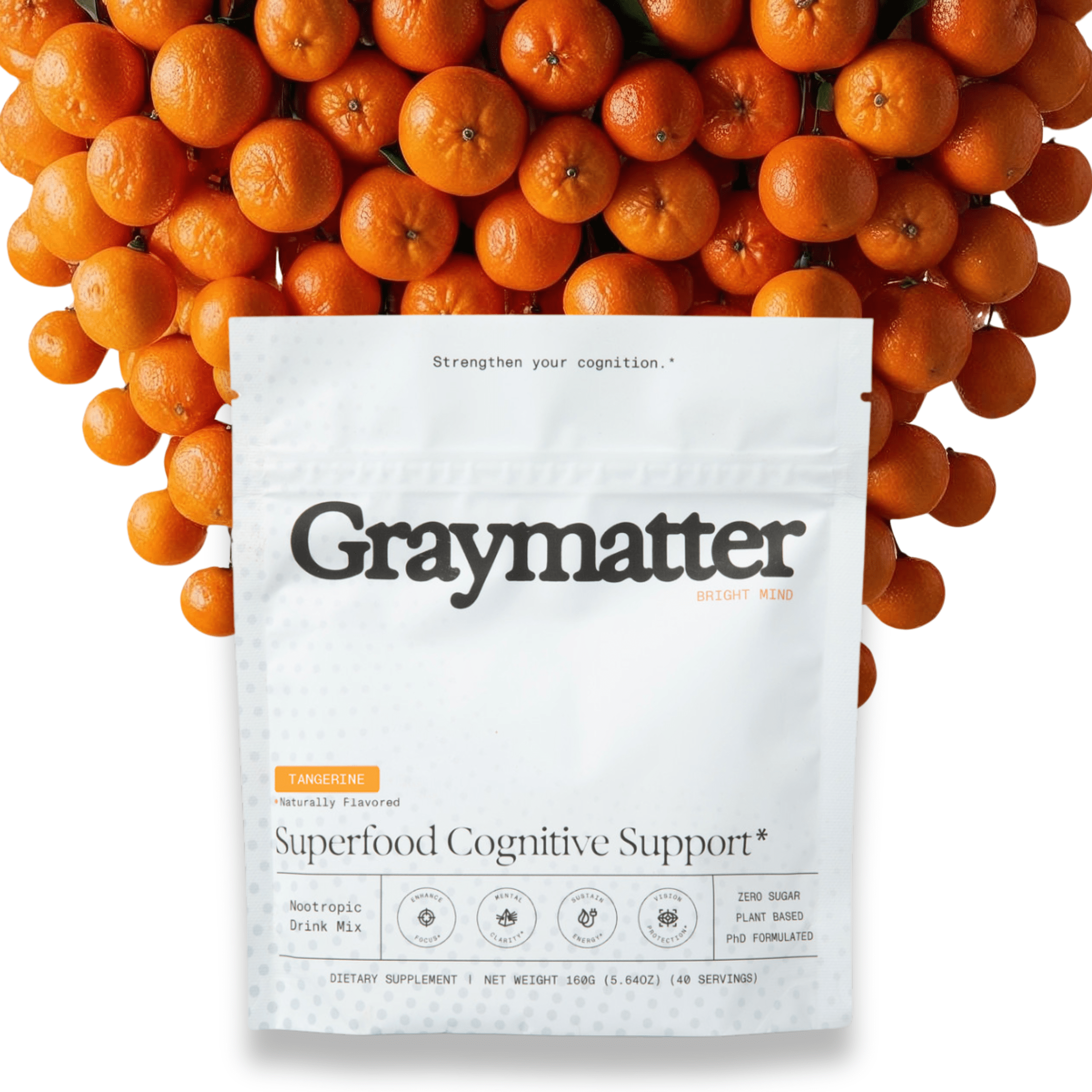
Graymatter Bright Mind delivers naturally occurring L-theanine through Korean Matcha and Green Tea Extract as part of a 27-ingredient, plant-based formula to support calm energy, sustained focus, and daily mental clarity.
Compliance note: Graymatter Bright Mind is a dietary supplement that supports focus and cognitive function; not intended to diagnose, treat, or cure any medical condition. Please consult a healthcare provider regarding any treatment plan.
FAQs
What is L-theanine?
L-theanine is a non-protein amino acid found in green and black tea. The compound promotes relaxation without sedation and may support focus, mood, and stress resilience.
How much L-theanine should you take per day?
Most research uses doses between 100-400 mg daily, depending on the purpose. General calm focus typically calls for 100-200 mg, while stress support uses 200-400 mg.
What is the best L-theanine dosage for anxiety?
Research has most commonly used 200-400 mg per day for anxiety-related support. Effects may be noticeable within 30-60 minutes of a single dose.
Can you take L-theanine with caffeine?
Yes. L-theanine and caffeine are commonly paired at a 1:1 to 2:1 ratio, and the combination may support sustained attention without jitteriness.
Is L-theanine safe to take every day?
At doses up to 400 mg per day, L-theanine appears well-tolerated in healthy adults. Consult a healthcare provider before starting any new supplement regimen.
Leave a comment