


For most of the 20th century, neuroscience operated under a quiet assumption: the brain you have in your twenties is, more or less, the brain you're stuck with. Neurons died off. Connections faded. Cognitive decline was treated as a one-way road.
That story turned out to be wrong.
Over the last two decades, research has fundamentally reshaped how we understand the adult brain. We now know it is remarkably plastic. It has the capability of reorganizing itself, forming new synaptic connections, and even generating new neurons in regions like the hippocampus well into older age.
This is the field of neurogenesis, and from my perspective as a physician with a regenerative medicine background, it's one of the most important shifts in modern health science.
It means cognitive performance is not something that we have to watch slip away as we age but a process where we are given a choice.So what is neurogenesis?
In plain language, neurogenesis is the process of your brain building new neurons which creates new neural pathways.
Where and how does it build these neurons and additionally build or strengthen new connections? It depends on how you use it. It's the biological basis of learning, memory, and adaptation.repeatedly, the brain reinforces the connection between those neurons. Over time, that reinforced pathway becomes faster, more efficient, and more durable.
That is neurogenesis in action. And it's happening, or not happening, based on how you use and fuel your brain every day.
"Your brain is not fixed, and it is not passive. It is a living, adaptive system that responds to what you feed it and how consistently you support it."
- Dr. Jeffrey Wiegers, MD
Why This Matters for Everyday Cognitive Performance
Most people have been taught to think about brain health in short-term terms. A better morning. A sharper meeting. A focused afternoon. Those benefits are real but they are the tip of a much larger iceberg.
The real story is what happens when you stack those days together.
When your brain has consistent access to the neurotransmitter precursors and adaptogenic compounds it needs, something more significant begins to unfold. Daily neurotransmitter support neuromodulates your focus and sustained attention, meaning it steadies the signals your brain uses to pay attention, regulate mood, and manage stress in the moment.
Repeat that modulation consistently, and you create the biological conditions for neurogenesis: stronger, more connected neural pathways that show up as sharper thinking, steadier mood, and greater mental stamina over the long arc.
In other words, the same behaviors that help you focus today are the behaviors that wire a better-performing brain for tomorrow.
The Orchestra: How Graymatter's Ingredients Work Together
A well-formulated nootropic doesn't rely on a single hero ingredient. That's a stimulant's approach. Blast one system hard and hope the rest keeps up. A functional medicine lens tells us the brain is far more nuanced than that.
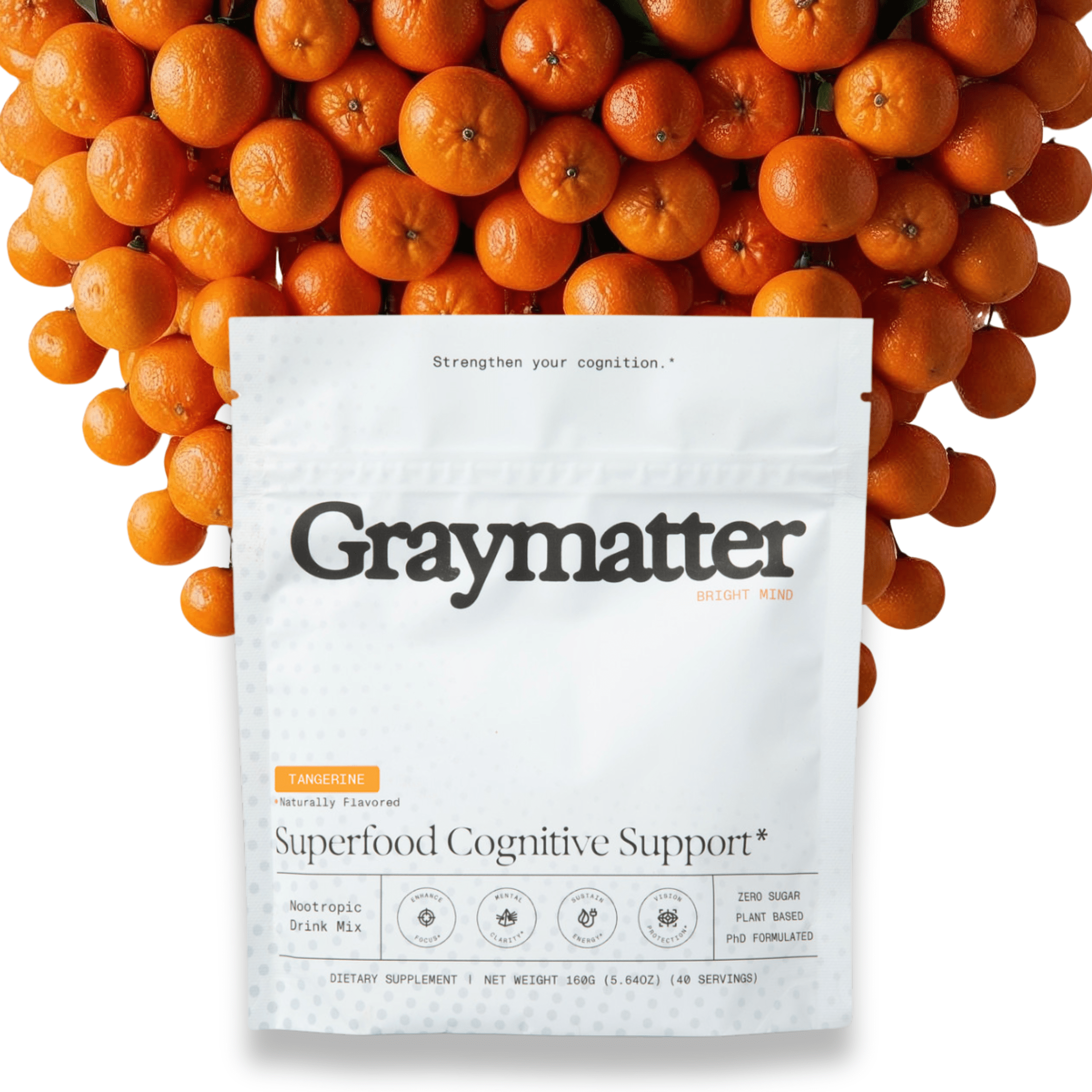
I think about Graymatter's formulation the way I'd think about an orchestra. No single instrument carries the performance. What matters is how they play together and whether they're in balance.
The neurotransmitter section Alpha-GPC, L-Tyrosine, and Phosphatidylserine all supply the raw precursors your brain uses to produce acetylcholine and dopamine, the chemistry behind focus, motivation, and mental drive.
The circulation section: Nitrosigine supports cerebral blood flow, so those precursors and the oxygen they need actually reach the tissue that uses them.
The adaptogen section: Lion's Mane, Ashwagandha, Rhodiola, Cordyceps, and Red Panax Ginseng modulate the stress response and support neurotrophic signaling, which is directly tied to your brain's capacity to form new connections. Lion's Mane in particular has drawn significant research interest for its role in nerve growth factor activity.
The energy section: green tea, matcha, and guarana provide steady, plant-based energy without the tolerance curve of isolated caffeine.
And the protective section: lutein, zeaxanthin, astaxanthin, and vitamins C and E support the brain and visual system against oxidative stress, the slow background erosion that undermines long-term cognitive health.
None of these is doing the job alone. What makes the formulation work is the synergy: each instrument playing its part, keeping the system in balance. That balance is what allows for sustained, daily use without the crash-and-rebuild cycle stimulants create.
The Long-Term Takeaway
If there's one idea I'd want readers to walk away with, it's this: your brain is not fixed, and it is not passive. It is a living, adaptive system that responds to what you feed it and how consistently you support it.
Neurogenesis is not a marketing concept. It's an established biological process and an important one to care for properly. A single dose of anything, on any given day, is not what moves the needle.
What moves the needle is showing up for your brain every day, with inputs that support both the moment-to-moment chemistry of attention and the long-term architecture of cognitive health.
This is the principle Graymatter was built around. It isn't a stimulant strategy. It's a daily, plant-based, holistic approach to the brain. At its best, it is used the way good nutrition is used: consistently, over years, as a foundation.
That's the real payoff. Not a better hour. A better decade. A better life.
About the author
Dr. Jeffrey Wiegers, MD is a regenerative medicine specialist, board-certified anesthesiologist and pain specialist serving patients in Santa Monica and Silicon Valley. He focuses on minimally invasive therapies designed to restore function and relieve chronic pain.